
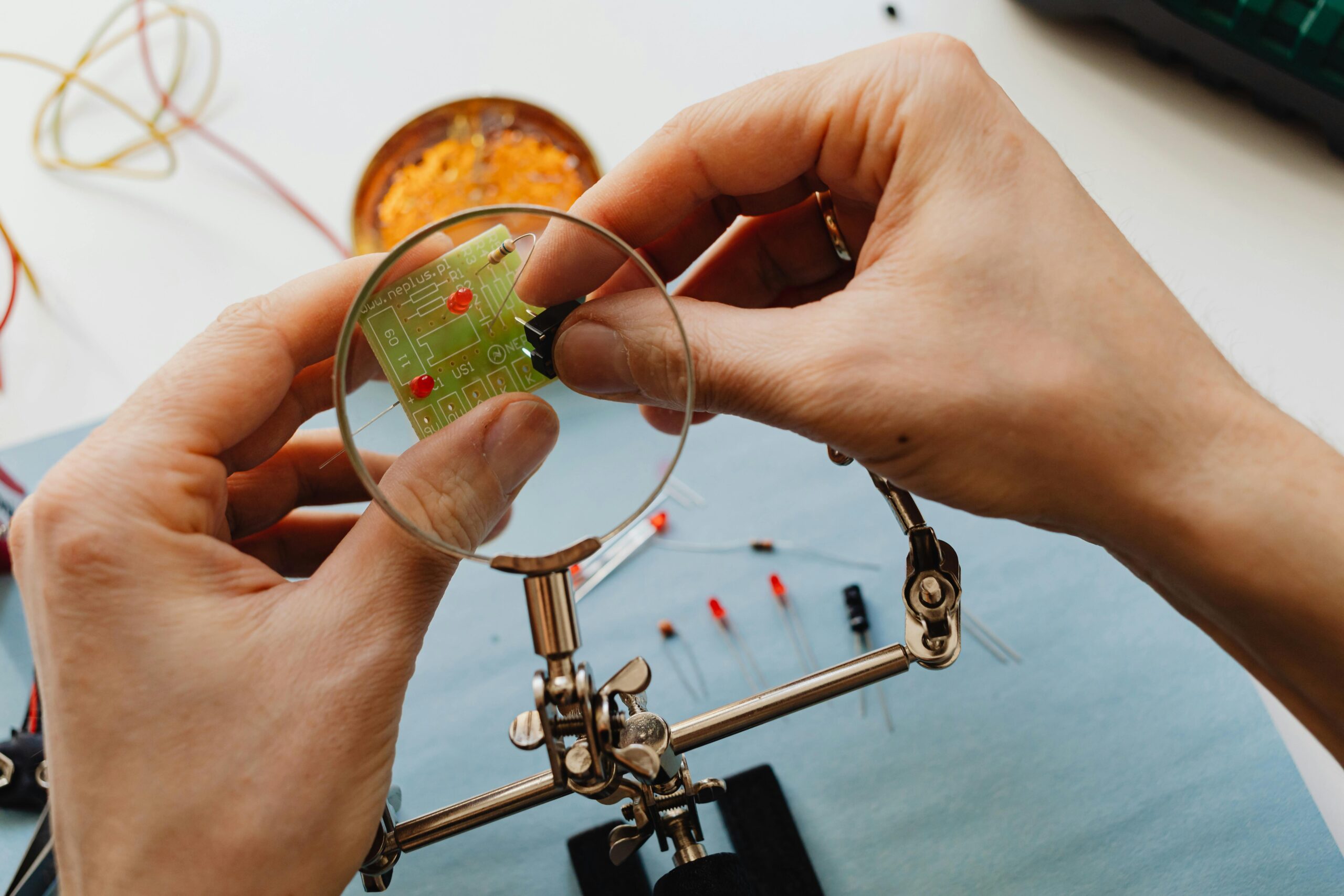
What Are Microchips Made Of? Semiconductors & Photonics
At its core, a microchip is a precisely layered structure of semiconductor, conductive, and insulating materials. The function of the chip depends not on any one of them, but on how they are arranged, separated, and connected at scales measured in nanometres.
From Sand to Silicon: The Foundation of Microchips
Silicon is the starting point. It is derived from silica, the compound that makes up ordinary sand, and refined into a form pure enough to behave as a semiconductor: a material that conducts electricity under some conditions and resists it under others. That controllable conductivity is what makes it useful for building logic circuits.
Conductivity is adjusted by doping, in which small quantities of phosphorus or boron are introduced into the silicon lattice. Phosphorus adds free electrons, creating n-type silicon. Boron creates electron gaps, or holes, yielding p-type silicon. The junction between these two types is the basis of the transistor.
The silicon chip begins as a wafer. Molten silicon is grown into a cylindrical ingot and sliced into thin discs, typically 200mm or 300mm in diameter. These wafers serve as the substrate on which all subsequent processing takes place. A wafer is the base material before fabrication; a microchip is the finished device cut from that wafer after fabrication is complete. One wafer yields hundreds of individual chips, depending on device size.
The Core Materials Behind Microchip Functionality
Three categories of material work together inside every chip.
Semiconductor materials, primarily silicon, form the active elements: the transistors that switch and amplify electrical signals. Conductive materials, typically copper and aluminum, form the interconnects that carry those signals between transistors. Insulating materials, known as dielectrics, separate the conductive layers and prevent signal interference.
The layered structure matters as much as the individual material choices. A modern chip may contain ten or more metal interconnect layers, each separated by a dielectric film. Current flows where the conductor is present. It does not flow where the insulator intervenes. Managing the interaction between these layers across billions of transistors, at nanometre tolerances, is what advanced semiconductor fabrication involves.
How Microchips Are Built: A Layered Manufacturing Process
Chip fabrication is not a single step. It is a sequence of repeated cycles, each adding or removing material from the wafer surface with precision.
- Deposition coats the wafer with a thin layer of material, whether a dielectric, a metal, or a semiconductor film.
- Lithography patterns that layer by exposing a light-sensitive coating to ultraviolet light through a mask, defining where material stays and where it is removed.
- Etching removes the exposed or unexposed material, depending on the chemistry used.
- Doping implants ions into defined regions to alter local conductivity.
Each cycle builds one layer of the final device. The full process runs through dozens of these cycles before a wafer is complete.
Beyond Silicon: Materials Enabling Next-Generation Devices
Silicon processes reliably and scales well, but it has physical limits that matter for the applications now driving semiconductor demand.
For high-frequency electronics and power management, gallium nitride (GaN) and silicon carbide (SiC) offer electron mobility and thermal tolerance that silicon cannot match. GaN-based devices are already deployed in power conversion and radio frequency applications. SiC operates at voltages and temperatures where silicon fails.
For photonics, the constraints are more fundamental. Silicon does not emit light efficiently, and its electro-optic response is weak. Silicon nitride (SiN) provides low optical loss for passive waveguide functions. Lithium niobate, particularly in thin-film form, enables high-speed modulation through the Pockels effect, where an applied electric field shifts the refractive index of the material directly, without the carrier movement that limits silicon at high frequencies. Indium phosphide handles light generation and detection with efficiency silicon cannot approach.
These next-generation materials are not replacing silicon. They are being integrated alongside it, each assigned the function its physics is best suited to perform.
The Real Challenge: Integrating Materials into Scalable Systems
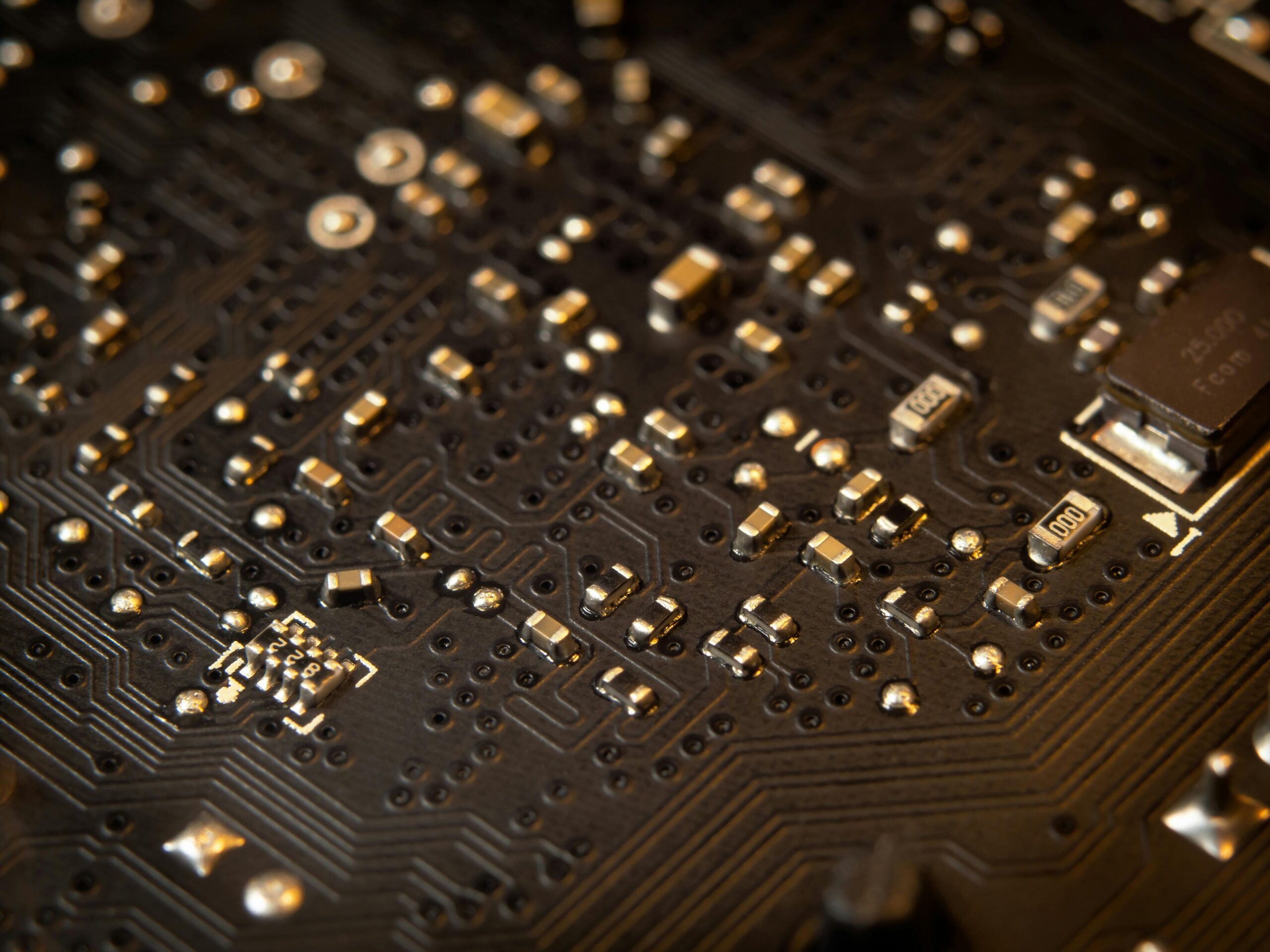
Selecting the right material for a function is the straightforward part. Integrating it into a manufacturable system is where the difficulty compounds.
Different materials expand and contract at different rates under thermal load. A bonding process that holds at room temperature may introduce stress or delamination at process temperatures. Lattice mismatch between dissimilar materials generates crystal defects that degrade device performance. Process chemistries optimised for silicon may damage or contaminate materials introduced later in the fabrication sequence.
This is where heterogeneous integration becomes the defining challenge. Heterogeneous integrations refers to the assemblies of multiple semiconductor and photonic materials into a single device, with each material performing a distinct function. The integration can occur at the wafer level, through die-to-wafer (D2W) bonding, or at the package level. Either way, the process must hold at the tolerances required for high-volume manufacturing, not just for a laboratory prototype.
Yield is the operational measure. A process that produces working devices at prototype scale but degrades at volume is not a manufacturable process. Compatibility, thermal management, and yield must be solved together.
From Materials to Manufacturable Devices
Most advanced material systems demonstrate compelling results at the research stage. The transition to manufacturable devices is where the majority of innovations stall.
Scaling a process from a single wafer to hundreds per week exposes variability that a prototype run does not. Repeatability requires tight control over deposition thickness, etch selectivity, doping concentration, and bonding alignment, across every wafer in every run. Drift in one parameter propagates through the device stack.
Fabrication constraints also narrow the design space. A material that requires high-temperature processing may be incompatible with materials already on the wafer. A bonding technique that works on a 100mm substrate may not transfer to a 300mm platform without process redevelopment.
How NSTIC Supports Advanced Semiconductor and Photonic Materials
The National Semiconductor Translation and Innovation Centre (NSTIC) operates at the boundary between research demonstration and manufacturable technology. That boundary is where the challenges described above concentrate.
For photonics applications, NSTIC’s 300mm wafer cleanroom, a Class 10/100 facility with a full lithography, etch, deposition, epitaxy, and metrology toolset, supports both prototyping and small-volume fabrication. The platform integrates advanced material systems including thin-film lithium niobate (TFLN), barium titanate (BTO), and III-V semiconductors on silicon substrates. These capabilities are available for collaborative engagement today.
Semiconductor innovation in photonics requires solving integration and manufacturability challenges that laboratory results leave open. NSTIC’s translational R&D model is built around exactly that. Work developed at the centre is designed to be foundry-transferable, connected from prototype to scalable process flow from the start.
From Silicon Foundations to Integrated Photonic Futures
The microchip began as a silicon device. It is now a multi-material system, where the choice of substrate, modulator, emitter, and waveguide determines what a device can and cannot do.
The progression from sand to silicon to heterogeneous photonic integration reflects a recurring pattern: each performance ceiling drives adoption of a material better suited to what comes next. As data rates, sensing demands, and miniaturisation push past what silicon alone can deliver, the materials integrated alongside it become as consequential as the silicon itself.
Translating those materials into products requires infrastructure, process expertise, and a fabrication model built around industrial readiness. That is where the devices of the coming decade will be decided.