
Wafer Fabrication at the R&D Translation Stage: From Concept to Industry-ready Devices
What is wafer fabrication? The standard answer is straightforward: it’s a series of highly controlled processes used to build semiconductor devices layer by layer on a silicon wafer. These steps transform a blank substrate into integrated circuits, sensors, photonic devices and advanced components that power modern computing, communication and sensing systems.
However, the real challenge in today’s semiconductor landscape lies in translating fabrication knowledge into industry-ready, scalable devices. A laboratory demonstration may prove that a device concept works, but turning that concept into a robust, manufacturable technology is an entirely different problem.
Here’s where R&D translation platforms play a critical role. By bridging research and industry, advanced facilities such as NSTIC enable companies to move beyond proof-of-concept prototypes towards scalable solutions that meet industrial standards.
What Wafer Fabrication Really Means in Modern Semiconductor Engineering
A wafer fabrication facility, commonly known as a semiconductor wafer fab, is the heart of the semiconductor value chain. It’s where raw wafers are processed through hundreds of tightly controlled steps to create integrated circuits and advanced devices. In commercial production, fabs operate with extreme precision, stringent contamination control and highly optimised process flows to ensure yield and repeatability.
However, modern wafer fabrication is not simply a checklist of process steps, but a system-level discipline. Each deposition layer affects subsequent lithography, and each etch step influences device performance and reliability. Thermal budgets must be carefully managed to avoid degrading previously formed structures. Process integration becomes increasingly complex as devices scale in performance and density.
For organisations exploring advanced photonics, heterogeneous integration or novel materials, the gap between understanding fabrication theory and solving real process engineering challenges can be significant.
The Core Stages of Wafer Fabrication
While process flows vary depending on device architecture, the core stages of wafer fabrication remain foundational.
- Deposition: This stage involves adding thin films that define electrical, optical or mechanical functionality. As device complexity grows, precise control over thickness uniformity, material quality and stress becomes increasingly critical.
- Lithography: Circuit or device patterns are transferred onto the wafer surface. At advanced nodes and for photonic structures, alignment tolerances and feature resolution requirements become extremely demanding.
- Etching: Materials are selectively removed to form device geometries. Achieving high aspect ratios, smooth sidewalls and minimal defects across large wafers introduces substantial engineering challenges.
- Implantation: Here, the electrical properties of semiconductor regions are modified. Precise dose control and thermal management are essential to ensure predictable device performance.
- Chemical mechanical polishing (CMP): This stage ensures surface planarity, which is vital for multi-layer integration. As stacking complexity increases, even small deviations in flatness can affect yield.
- Packaging and Test-preparing Devices: For photonic and heterogeneous systems, advanced packaging techniques must accommodate both electronic and optical interfaces.
At each stage, scaling to larger wafers and tighter tolerances increases complexity exponentially. This is why semiconductor wafer fabrication at the R&D stage requires more than basic process capability; it demands integrated process engineering.
The Disconnect: Why Lab Demonstrations Don’t Equal Manufacturable Devices
In academic and early-stage research settings, devices are often fabricated on smaller wafers with limited process integration. Demonstrating functionality at this level is an important milestone. However, success in the lab does not automatically translate into manufacturability.
When processes are scaled to full wafers, yield variations emerge. Defect density becomes visible, and uniformity across the entire wafer surface becomes critical. Minor process instabilities that were negligible on a small scale can result in significant yield loss on a larger scale.
Without a structured R&D fabrication environment designed to simulate industry conditions, promising concepts may fail to transition into commercially viable technologies.
Real Wafer-level Engineering Challenges Companies Face
At wafer scale, several practical challenges frequently arise. This includes:
- Defect Control: Surface flatness and defect control across large wafers are essential to maintain yield. Even small variations can affect downstream lithography and integration.
- Cross-process Integration: Tolerances must be tightly managed. Interactions between deposition, etching and CMP can introduce variability if not carefully optimised.
- Material Integration: Material compatibility and thermal budgets become more complex when integrating dissimilar materials, particularly in heterogeneous integration and advanced photonics.
- Repeatability: Yield, repeatability and early reliability considerations must be addressed early in development. Process flows must be stabilised before technology transfer or scale-up.
- Packaging and Integration: Co-packaged optics and advanced chiplet architectures require alignment precision and thermal management strategies that extend beyond traditional device fabrication.
From Prototype to Pilot: How Wafer Fabrication Changes When You Scale
The difference between a laboratory fabrication setup and an industry-grade environment becomes most evident during scaling.
- In small-scale labs, process tools may lack the automation, uniformity control or contamination management found in commercial fabs. While suitable for experimentation, these environments may not reveal integration challenges that emerge at a larger scale.
- Moving to a 300 mm wafer platform changes the equation. Uniformity requirements become stricter. Equipment calibration and process repeatability are more rigorously tested. Integration interactions across the wafer surface become visible.
For companies exploring wafer fabrication in Singapore, access to an industry-aligned 300 mm cleanroom environment enables early identification of scale-related issues. This reduces downstream risk and shortens the path to pilot production.
How R&D Translation Platforms Enable Next-generation Fabrication
R&D translation platforms are designed to bridge the gap between academic discovery and commercial manufacturing. By operating as a semiconductor fabrication research and development facility, such platforms provide industry-grade tools and integration expertise within a collaborative framework. Access to cleanrooms allows realistic prototyping under conditions aligned with commercial manufacturing.
Equally important is collaborative process development. Engineers can iterate on process flows, refine integration strategies and validate performance metrics before committing to full-scale production.
Case Scenarios Where Translation Matters
- Photonic Integrated Circuits: Optical performance depends on dimensional precision and low-loss interfaces, which must be consistent across the wafer.
- Novel Material Systems: Systems such as advanced electro-optic materials integrated onto silicon platforms demand specialised deposition techniques and carefully managed thermal budgets.
- Early-stage Devices: Devices intended for licensing or scale-up require stable, repeatable process flows. Without wafer-level validation in a controlled environment, technology transfer can stall.
In each scenario, translation-focused R&D fabrication capabilities determine whether a concept remains confined to the lab or advances towards industrial relevance.
From Concept to Scalable Technology
Wafer fabrication is the foundation of next-generation semiconductor and photonic innovation, determining whether these technologies can scale reliably and economically. Yet, the gap between laboratory demonstrations and manufacturable devices is often underestimated. Yield, integration stability and wafer-scale uniformity challenges emerge only when technologies are tested in industry-aligned environments.
Translation-focused platforms such as NSTIC provide the missing link. By combining translational R&D, advanced cleanroom access and collaborative process development, NSTIC enables companies to move from concept to industry-ready devices with confidence.
How NSTIC Supports Wafer Fabrication Challenges
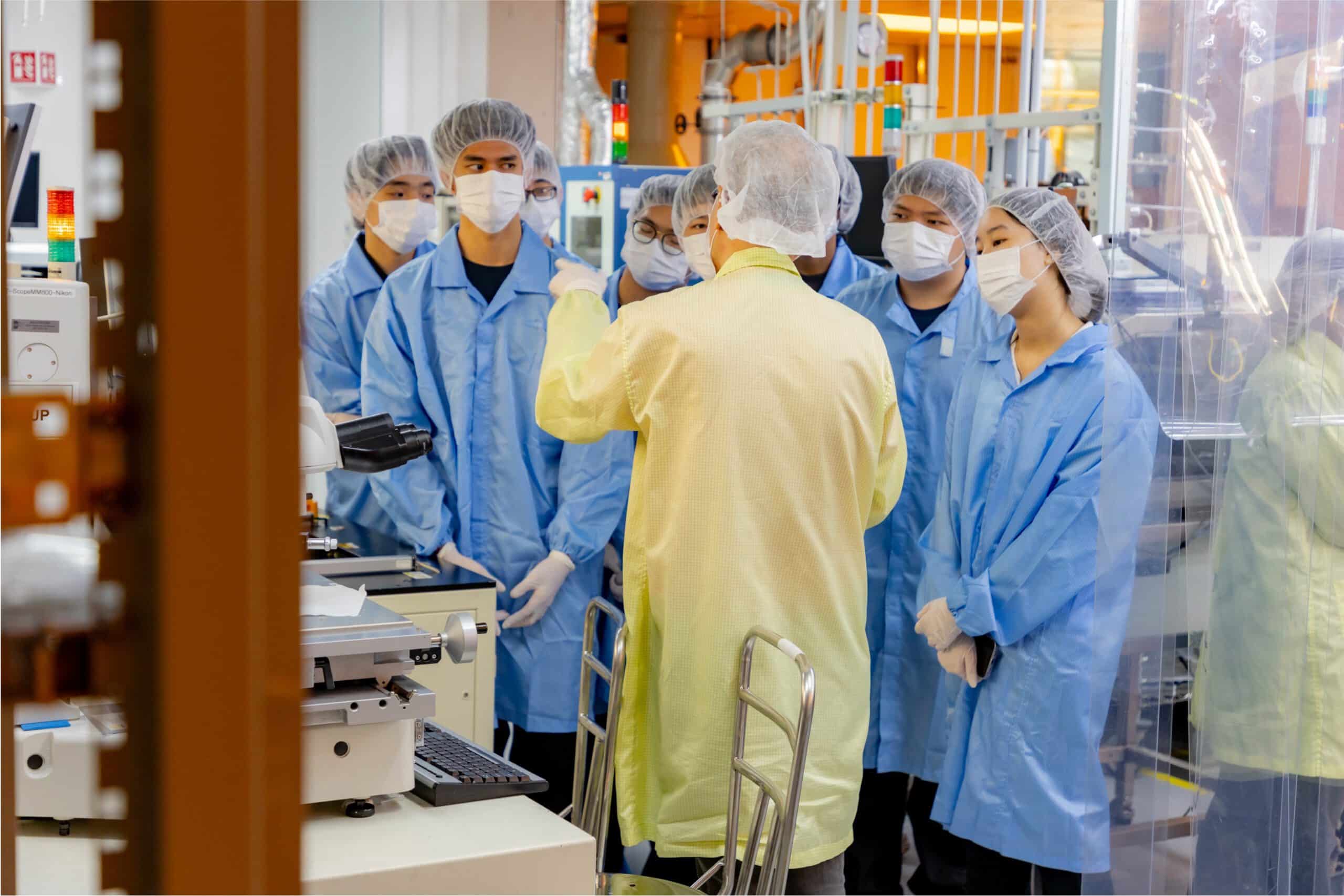
Operating at the intersection of research and industry, NSTIC supports advanced wafer fabrication and semiconductor wafer fabrication initiatives through translational R&D. Our 300 mm wafer cleanroom provides a realistic environment for prototyping, testing and refinement under industry-aligned conditions. We also support technology licensing, enabling faster time-to-market for validated intellectual property in flat optics, silicon photonics and advanced semiconductor fabrication.
Hosted under A*STAR, NSTIC brings together leading research institutes and universities to deliver national-level R&D translation for flat optics and silicon photonics. This ecosystem provides companies with access to advanced infrastructure, integrated prototyping workflows and deep domain expertise, strengthening Singapore’s semiconductor value chain while accelerating scalable innovation.
Partner with NSTIC to translate your innovations into industry-ready, scalable technologies today.