
Optical Sensors: From Conventional Types to Integrated Photonic Systems
Optical sensing has moved from discrete components to integrated platforms over the past decade, and the engineering constraint has moved with it. Alignment tolerances and bench-scale optomechanics once limited what could be deployed; the bottleneck now sits at the wafer level, in integration density, material compatibility, and process repeatability.
What Are Optical Sensors and How Do They Work
An optical sensor detects light and converts it into an electrical signal. The architecture has three parts: a light source (or ambient illumination), an interaction with a target that modifies the light in a measurable way, and a photosensitive element that translates the returning photons into current or voltage. Signal processing electronics interpret that output as a temperature, a distance, a concentration, a position, or whatever physical quantity the system was designed to measure.
The choice of light source, wavelength band, detector material, and optical path geometry determine what the sensor can resolve. Everything downstream, including the system the sensor is built into, follows from those choices.
Common Optical Sensor Types and Their Roles
Three categories dominate deployed systems.
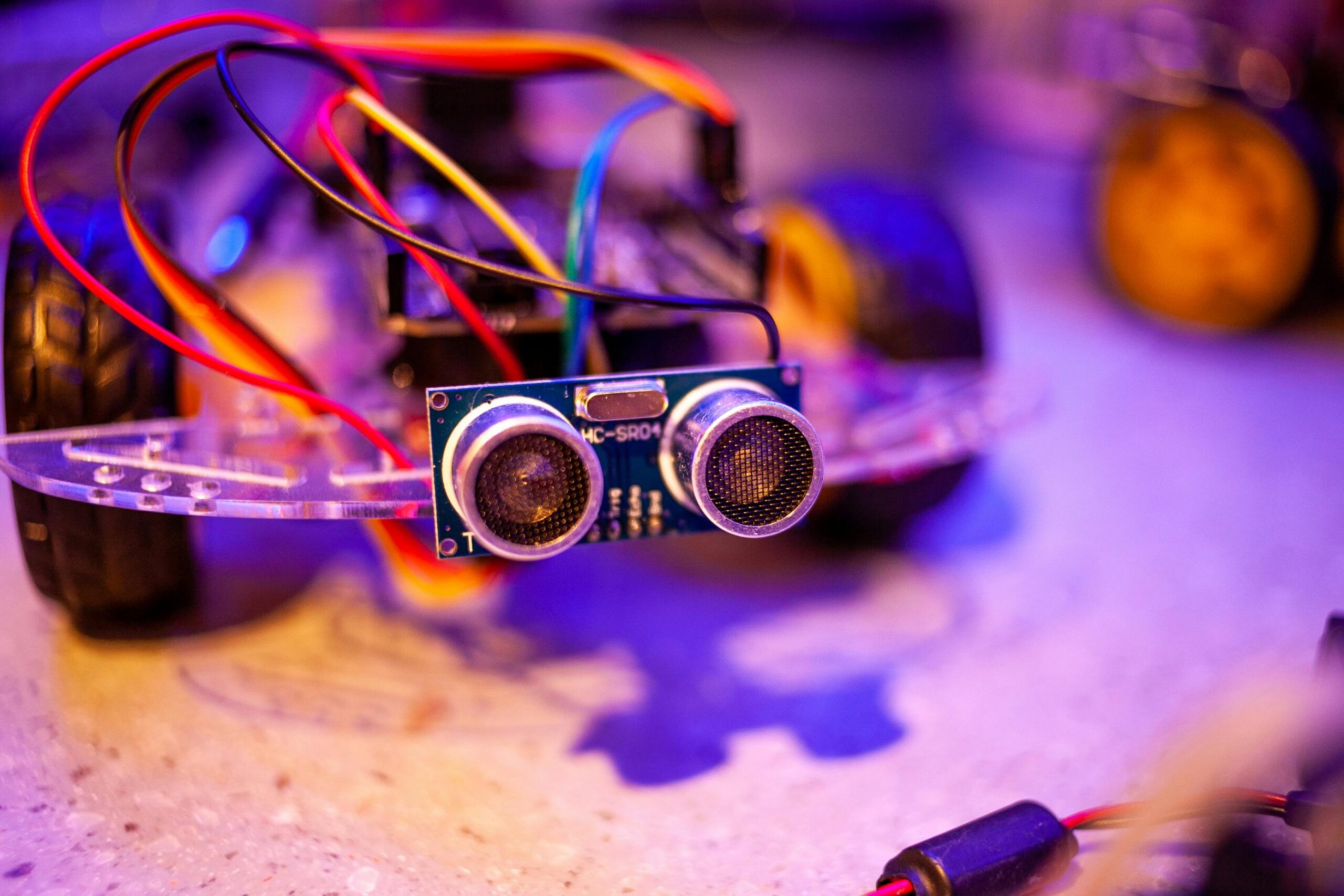
- Photodiodes and phototransistors handle the conversion of light to current at the device level. They are the workhorse detectors inside almost every optical instrument, from barcode scanners to spectrometers to light detection and ranging (LiDAR) receivers.
- Fibre optic sensors use the fibre itself as the sensing element. Strain, temperature, or chemical exposure perturbs the light travelling through the fibre, and the perturbation is measured at the far end. The architecture suits distributed sensing across kilometres of pipeline or structural infrastructure.
- Photoelectric sensors detect the presence, absence, or position of objects by interrupting a beam between an emitter and a receiver. They are the basis for industrial automation, automotive proximity detection, and access control.
These are building blocks rather than complete systems. The performance limit of a deployed sensor usually does not lie at the device level. It sits in how the device is integrated.
The Limitations of Conventional Optical Sensor Designs
Conventional sensor architectures assemble discrete components: a source, one or more lenses, beam-shaping optics, a detector, and a circuit board. Each component is fabricated separately and brought into alignment during packaging, often to micron or sub-micron tolerances.
The cost shows up in three places:
- Volume and mass scale with the optical bill of materials, which limits where the sensor can be deployed.
- Alignment is sensitive to vibration, thermal expansion, and ageing, all of which degrade performance over the device lifetime.
- Scaling production means scaling the assembly of these discrete parts, and the unit economics flatten quickly as volume rises.
For applications where the sensor must be small, mechanically stable, and reproducible at scale, including automotive LiDAR, wearable diagnostics, and dense data centre monitoring, the conventional architecture has reached its ceiling.
From Components to Systems: The Shift Toward Integrated Optical Sensing
Integrated optical sensing places multiple optical functions on a single chip. The source, the waveguides, the modulators, the wavelength-selective elements, and in some platforms the detector itself are fabricated together on a common substrate, typically silicon or silicon-on-insulator.
This collapses the alignment problem. Photonic components patterned in the same lithography step are aligned to lithographic tolerances rather than assembly tolerances, thereby improving stability over temperature and time. The optical path shortens from centimetres to millimetres, which reduces optical loss and removes most of the mechanical packaging that conventional sensors carry.
The shift is not a question of one sensor outperforming its discrete predecessor. It is a change in how optical functions are organised, and it brings the sensor into the same manufacturing flow as the electronics it serves.
The Role of Advanced Photonics in Next-Generation Sensors
Advanced photonics extends the integrated sensor beyond what silicon alone can deliver. Photonic heterogeneous integration (PHI) bonds materials such as thin-film lithium niobate (TFLN), barium titanate (BTO), and indium phosphide onto a silicon platform, so each function operates near the physical limit of the material best suited to it. The waveguides stay on silicon nitride or silicon. The modulators move to TFLN. The light sources move to III-V semiconductors. The detectors sit on whichever material absorbs efficiently at the target wavelength.
The result is a sensor with higher precision, faster response, and a smaller footprint than a discrete or silicon-only equivalent. The breadth of photonics applications continues to widen on the back of this material flexibility, with the same integrated platform serving optical communications, ranging, biosensing, and metrology. The question of what is photonics used for increasingly has a unified answer: any system where light has to be measured precisely, moved efficiently, or generated at scale.
Manufacturing Challenges in Scaling Optical Sensor Systems
Moving an integrated sensor from a working prototype to a deployable product runs into constraints that emerge only at scale.
Optical alignment tolerances tighten as the optical path shortens, and a 100-nanometre shift between layers can move the operating wavelength of a resonant device out of specification. Material compatibility matters at every bonding interface, where thermal expansion coefficients, surface preparation, and post-bonding process budgets must all be controlled. Integration with electronics adds further constraints, because the photonic die must mate to a readout circuit with matched signal integrity and thermal behaviour. Yield falls quickly when any one of these tolerances is missed.
System-level integration sits on top of all of this. Packaging, fibre coupling, hermeticity, and qualification for the target environment are cost centres in their own right. Many promising sensor demonstrations stall at this stage, not because the device fails, but because the path from device to deployable system was never engineered.
How NSTIC Supports Advanced Optical Sensing Systems
NSTIC operates a 300mm wafer cleanroom dedicated to semiconductor photonics, with the full lithography, etch, deposition, epitaxy, thermal, chemical mechanical polishing (CMP) and metrology tool sets. The integration capability covers wafer-to-wafer bonding and chip-to-wafer placement, making heterogeneous platforms accessible to partners whose internal infrastructure ends at the lab bench.
We are developing photonics solutions that are designed from the start to be transferable to volume manufacturing, with CMOS process compatibility maintained throughout. Our R&D programmes in flat optics, photonic integrated circuits (PICs), and PHI feed directly into industry partnerships and developments in 2026. Photonics and optics system companies developing transceivers, LiDAR, and sensing platforms can engage through research collaboration, fee-for-service fabrication, or technology licensing.
Rethinking Optical Sensors as Integrated Systems
The progression from photodiodes and discrete optomechanics to integrated photonic systems is not a swap of one component for a better one. It is a change in where the engineering work happens. Performance, scalability, and manufacturability are no longer separable problems, and the sensor that reaches deployment is the one whose architecture answered all three in the same design loop.
The materials, the integration techniques, and the wafer-scale process flows that make this possible are advancing across the global ecosystem, and NSTIC is part of that work in Singapore.